

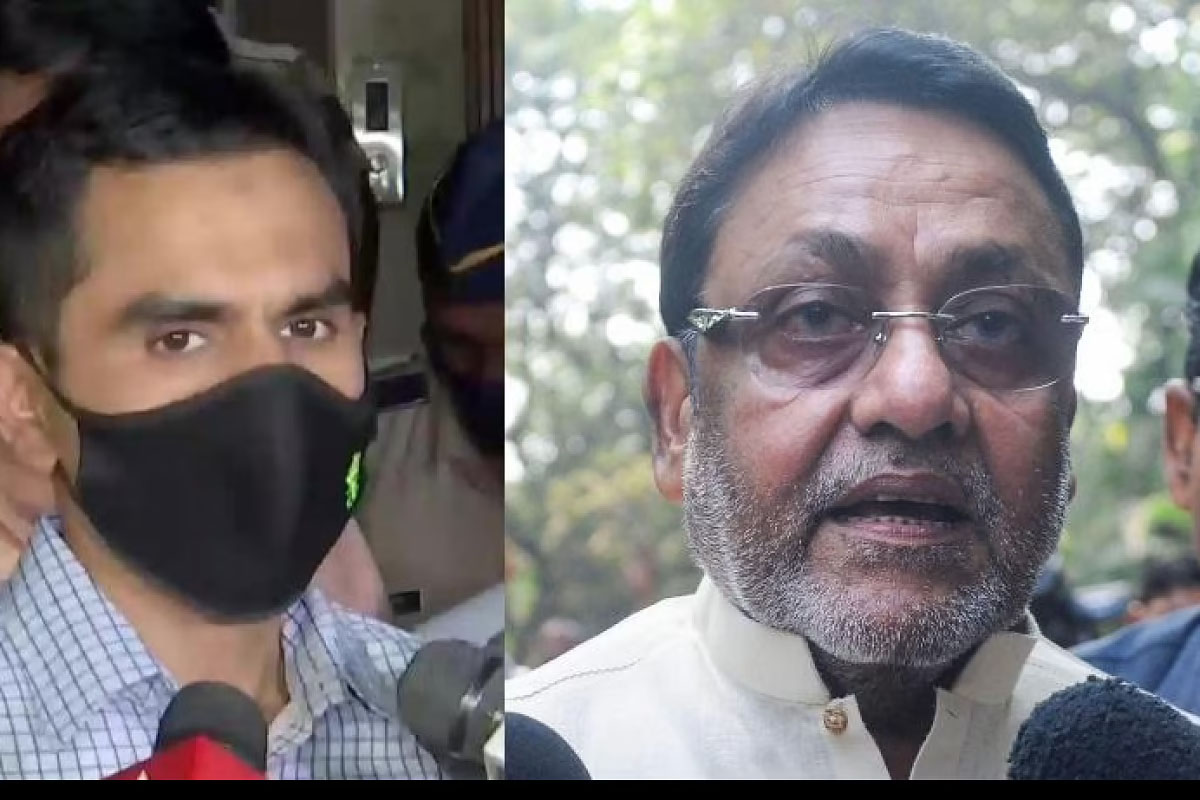
The life of Sameer Wankhede - as 'exposed' by Nawab Malik - explains a lot about how society and law operates.
The interesting case of Sameer Wankhede
- The story: The Aryan Khan drug and arrest case took many turns. The investigating agency and officers too came under a scanner, as Maharashtra Minister Nawab Malik alleged that Sameer Wankhede, the Mumbai Zonal Director of the Narcotics Control Bureau (NCB), had indulged in many misdemeanours.
- Allegations against Sameer Wankhede: Mr Malik said that Shri Dnyandev Kachru Wankhede (father of Sameer Wankhede) belonged to the Scheduled Castes (SCs), but converted to Islam before marrying Sameer’s mother, Zaheeda Begum.
- The birth certificate of Sameer (born 1979) carries his father’s name as Dawood K Wankhede and his own name as Sameer Dawood Wankhede.
- Sameer was raised as a Muslim, but was selected in the 2007 Civil Services Examination (CSE) under the SC quota. Mr Nawab Malik accuses that Sameer was not entitled to this reservation, and it is a fraud.
- Eligibility for SCs: As per the DoPT, no person who professes a religion different from Hinduism or Sikhism shall be deemed to be a member of the Scheduled Castes in India. There is a 15% quota for SCs in government jobs, but Hindu SCs who convert to Islam lose their SC status, and are no longer eligible for the quota.
- A person belonging to an SC or ST will continue to be deemed as such irrespective of his/her marriage to a non-SC/ST. A convert or re-convert to Hinduism and Sikhism shall be accepted as a member of SC.
- The rights of a person belonging to a Scheduled Tribe are independent of his/her religious faith.
- Constitution (Scheduled Castes) Order: Under the original Constitution (Scheduled Castes) Order, 1950, only Hindus were classified as SCs. The Order was amended to include Sikhs in 1956 and Buddhists in 1990. It now says that no person professing a religion different from Hinduism or Sikhism or Buddhism can be deemed to be a member of an SC. No such religion-based bar operates for STs and Other Backward Classes (OBCs).
- Why not Muslims and Christians: Petitions filed in the Supreme Court seeking the inclusion of Muslims and Christians in the SC category, have not been successful. In 2004, the Centre for Public Interest Litigation challenged the legality of the exclusion. In 2008, the National Commission on Minorities concluded that there was a case for inclusion of Dalit Christians and Dalit Muslims in the SC category. In 2020, the SC agreed to examine a plea by the National Council of Dalit Christians to make reservations religion-neutral, and it is pending.
- Caste in inter-caste marriages: In inter-caste marriages, the child carries the caste of the father, and caste certificates are issued on this basis. Courts have taken note of the surroundings in which the child was brought up.
- Rameshbhai Dabhai Naika vs State of Gujarat & Ors (2012) - Supreme Court ruling - In an inter-caste marriage or a marriage between a tribal and a non-tribal, there may be a presumption that the child has the caste of the father.
- This presumption may be stronger in the case where the husband belongs to a forward caste. But by no means is the presumption conclusive or irrefutable. It is open to the child of such marriage to lead evidence to show that he/she was brought up by the mother who belonged to SC/ST.
- False certificates: A Government servant should not be retained in service if it is found that s/he - (i) was not qualified or eligible in terms of the recruitment rules etc (or), (ii) had furnished false information or produced a false certificate in order to secure appointment. So Sameer Wankhede may face an inquiry, and may even be dismissed if his SC certificate is found to be false. The matter is politicised, and clarity is required on several questions such as – (i) whether his father was a Muslim when Sameer was issued his certificate, (ii) whether his father converted to Islam to marry and then re-converted, and if so, when, (iii) whether Sameer changed his religion to Hinduism just to receive an SC certificate.
- Summary: The Aryan Khan case has exposed many aspects of Indian state, and makes for a fascinating case study.
- EXAM QUESTIONS: (1) Explain the various technical allegations being levied against Sameer Wankhede, of the NCB, by minister Nawab Malik. (2) Explain the rules pertaining to reservations in S.C. category in India, from the perspective of religion.
#SC #ST #Dalits #Minorities #SameerWankhede
* Content sourced from free internet sources (publications, PIB site, international sites, etc.). Take your own subscriptions. Copyrights acknowledged.


